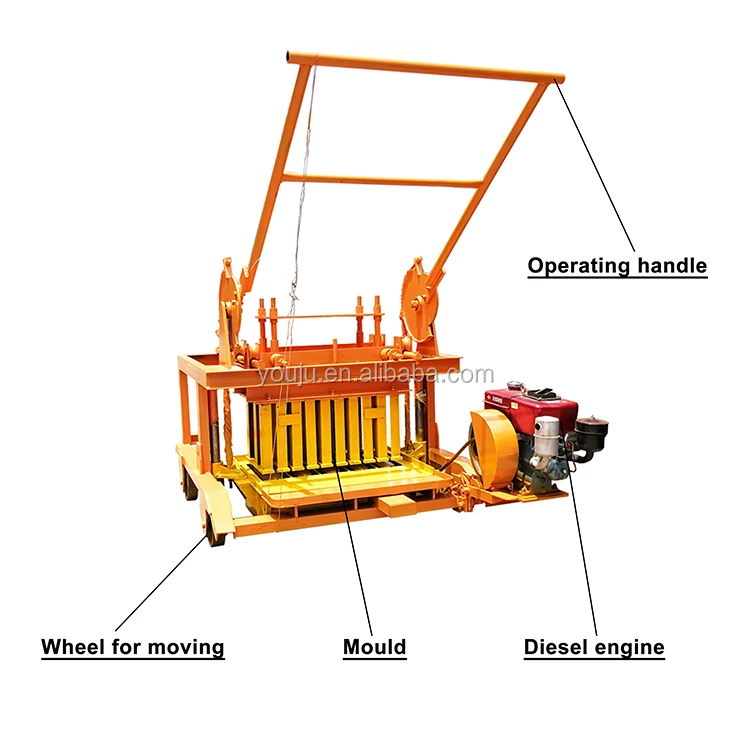
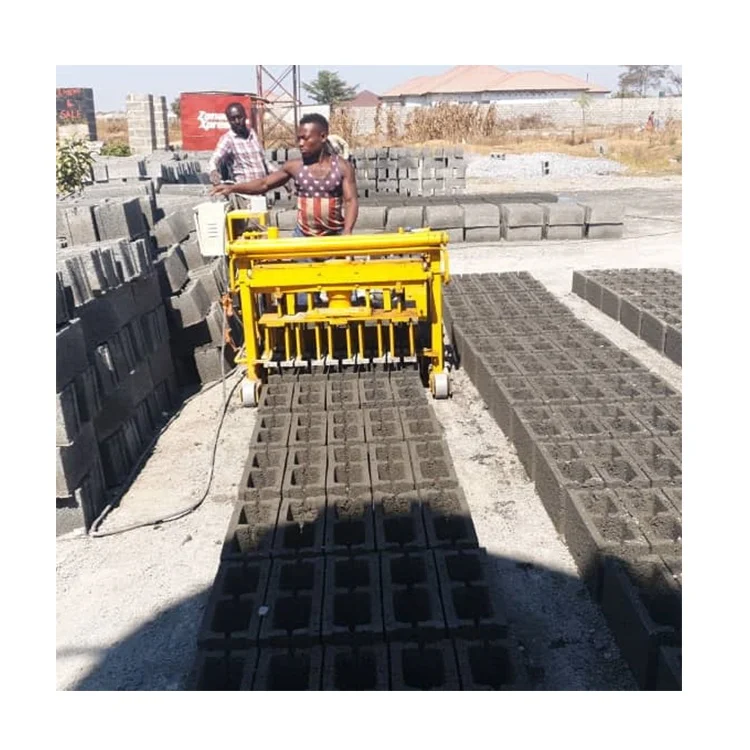
Configuration set against the buyer’s actual mix design — every QMJ2-45 machine ships with motor winding and frequency matched to the destination grid, not a catalogue default.
Technical Specifications
| Parameter |
Value |
| Model |
QMJ2-45 |
| Product Type |
Mobile Block Making Machine |
| Machine Type |
Manual mobile egg-laying block machine |
| Pallet Requirement |
No pallets required |
| Power Source |
Electric motor (diesel or other power not required) |
| Labor Requirement |
1 to 3 workers |
| Mould Change |
Manual, supports multiple hollow brick formats |
| Cycle Time |
25–30 s (basis: hollow brick formats listed below) |
| Output Capacity |
160 pcs/h based on 400×200×200 mm hollow brick, 2 pcs/mould |
| Output Capacity |
320 pcs/h based on 400×100×200 mm hollow brick, 4 pcs/mould |
| Mobility |
Free-moving, no fixed plant or pallet system required |
| Operating Space |
Suitable for small space |
| Control System |
Manual operation (no PLC) |
| Automation Level |
Manual |
| Stacking Method |
Manual (no automatic stacking) |
| Standards |
ISO 9001:2000, CE (verify certificate validity and scope) |
Application Suitability
| Application |
Material or Output |
| On-site hollow block production |
Cement, sand, crushed stone or gravel aggregate |
| Small-scale block startup |
Lightweight aggregate or fly ash mixes within manual compaction limits |
| Remote project block supply |
Locally sourced sand and stone without fixed batching plant |
| First block plant for entrepreneurs |
Standard concrete mix with minimal capital and space |
What "Pieces per Hour" Actually Means on a QMJ2-45
Cycle time and output shift the moment you change the block format — quoting a single number without naming the brick hides the truth.
Every mobile block making machine manufacturer lists a headline capacity, but that figure usually assumes the smallest or lightest block the mould can produce. When a buyer arrives on site expecting 320 pieces per hour and the market needs 400×200 mm hollow blocks, real output drops to less than half. I have stood next to operators counting blocks at the end of a shift while the project manager points at the brochure number. The gap between catalogue output and site output is where trust breaks down. [NEED_CITE: capacity calculation standards for mobile block machines]

Where the QMJ2-45 Fits in the Block Machine Range
The QMJ2-45 sits at the entry tier of the mobile block machine range, aimed at buyers who need hollow block production without investing in pallets, a curing rack system, or a fixed plant footprint. It moves on its own wheels across a flat concrete yard, laying blocks directly on the ground while the operator walks behind. For a contractor who needs a few hundred hollow blocks a day at a housing project, this mobile block making machine manufacturer offers the lowest capital entry point before stepping up to semi-automatic stationary lines.
Output Transparency by Block Format
Rather than publishing one capacity number, the QMJ2-45 output is stated per format: 160 pieces per hour on 400×200×200 mm hollow blocks (2 per mould), and 320 pieces per hour on 400×100×200 mm hollow blocks (4 per mould). The difference comes from mould cavity count, not machine speed — cycle time stays within 25 to 30 seconds across formats. Buyers planning daily targets should multiply the format-specific hourly figure by available working hours, subtracting mould change and mix loading time. [NEED_CITE: egg-laying block machine cycle time variables]
Reading the QMJ2-45 Specifications for Your Site
Manual operation means the operator controls mix feeding and mould release without PLC or hydraulic pressure — block density depends on mix consistency and the operator’s technique rather than a preset pressure value. The no-pallet design eliminates pallet purchase and curing-area dependency, but it demands a smooth, level concrete surface; soft ground causes blocks to tilt before initial set. Cycle time of 25 to 30 seconds per mould assumes a ready mix within reach — any delay in mix delivery extends the real cycle. The machine accepts mould swaps for three standard hollow formats, giving flexibility without requiring a second press.
When the Wrong Specification Choice Costs You Later
Ordering a mobile block machine without confirming motor voltage and frequency means the machine may arrive with a winding that does not match the local grid — a mismatch that shows up only when the contactor chatters or the motor overheats on the first day. I once watched a 60 Hz motor run on a 50 Hz supply; the reduced speed shifted the vibration rhythm and blocks came out under-compacted. The buyer lost two weeks sourcing a replacement motor locally while the project schedule slipped. [NEED_CITE: motor frequency mismatch effects on block density]
Why Source the QMJ2-45 Through This Range
Block machinery is our single focus, so the QMJ2-45 is specified as a matched system — machine, mould options, and spare parts list are confirmed together before production. Voltage, frequency, and motor winding are written into the contract rather than left to a default factory setting. Mould design covers the hollow formats your market actually sells, and custom drawings are available when standard sizes do not match local building codes. Installation support includes operator training on mix consistency and egg-laying technique, not just a manual in the crate. The automation upgrade path lets a buyer start with manual operation and move to a stationary line later without abandoning the first investment.
Documentation & Verification
- Machine specification sheet listing voltage, frequency, and motor winding confirmed per order
- Mould drawing and format list showing the exact hollow block sizes shipped
- Factory test record on your specified block format before dispatch
- Operation and maintenance manual covering manual mould change procedure
- Wear parts list with first replacement cycle intervals
Installation, Commissioning & Support
- Smooth concrete yard with minimum 100 mm slab thickness required for egg-laying operation
- Single-phase or three-phase power supply confirmed to match motor nameplate before connection
- Machine arrives fully assembled — no dismantling required beyond shipping restraints
- First-run commissioning covers mix proportioning and cycle rhythm with operator present
- Manual mould change training included, with spare bolt and pin set provided
- Grease points on guide rails and vibrator mounts marked for weekly service
What to Include in Your Inquiry
Tell us which hollow block format your market sells — 400×200, 400×150, or 400×100 mm — along with the local aggregate type and cement grade you plan to use. State your site voltage and frequency so the motor is wound correctly before the machine leaves the factory. If you already operate a mixer or plan to hand-mix, describe the setup so we can advise on mix delivery speed to the QMJ2-45.
Frequently Asked Questions
Q: How is the output capacity of the QMJ2-45 calculated, and what block format is each figure based on?
A: Output is stated per hollow block format, not as a single headline number. The machine produces 160 pieces per hour based on 400×200×200 mm blocks (2 per mould) and 320 pieces per hour based on 400×100×200 mm blocks (4 per mould). Cycle time remains within 25 to 30 seconds across formats. Daily output depends on working hours, mix delivery speed, and mould change frequency.
Q: What voltage and motor specifications are available to match different country power standards?
A: Motor voltage and frequency are confirmed per order before production. We specify the winding to match your local grid, whether 220V/60Hz, 380V/50Hz, or another standard. This is written into the contract so the machine arrives ready to connect without a transformer or motor swap on site.
Q: Which hollow block formats can the machine produce, and how long does a mould change take?
A: Standard moulds cover 400×200×200, 400×150×200, and 400×100×200 mm hollow blocks. Mould change is manual and requires basic hand tools. We recommend confirming the formats your market actually sells so the machine ships with those moulds installed and spares included for the first replacement cycle.
Q: What site conditions are required for pallet-free egg-laying operation?
A: The yard must have a smooth, level concrete surface so blocks sit flat after laying. Soft or uneven ground causes tilting before initial set. Adequate space around the machine is needed for mix delivery and block curing without a pallet rack system. Curing water access within hose reach keeps blocks moist during the first day.
Q: What moulds, spare parts, and technical support are included with delivery?
A: The machine ships with the hollow block moulds specified in the order, a wear parts list, and a first replacement set of high-wear components. Operator training covers mix proportioning, egg-laying technique, and manual mould change. Documentation includes factory test records on your specified format.

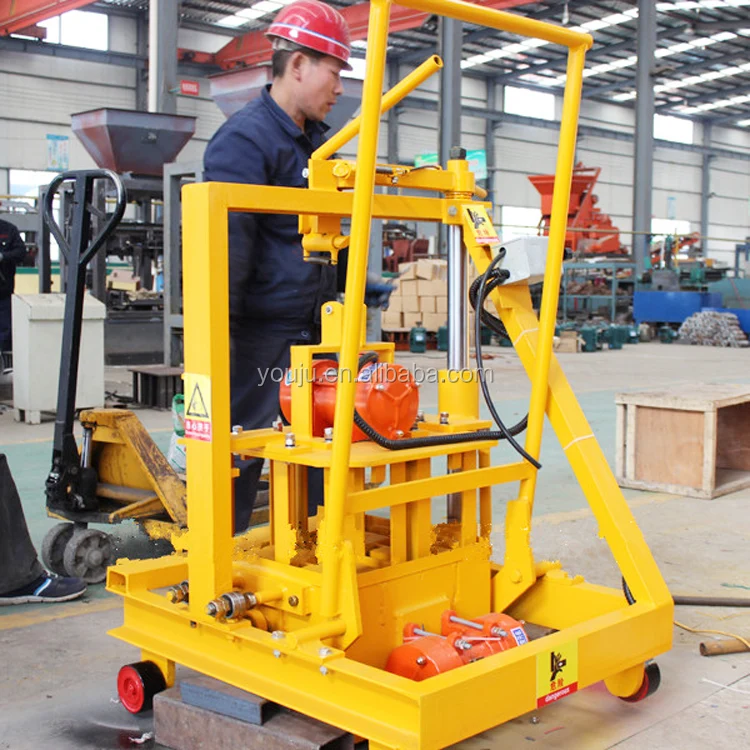
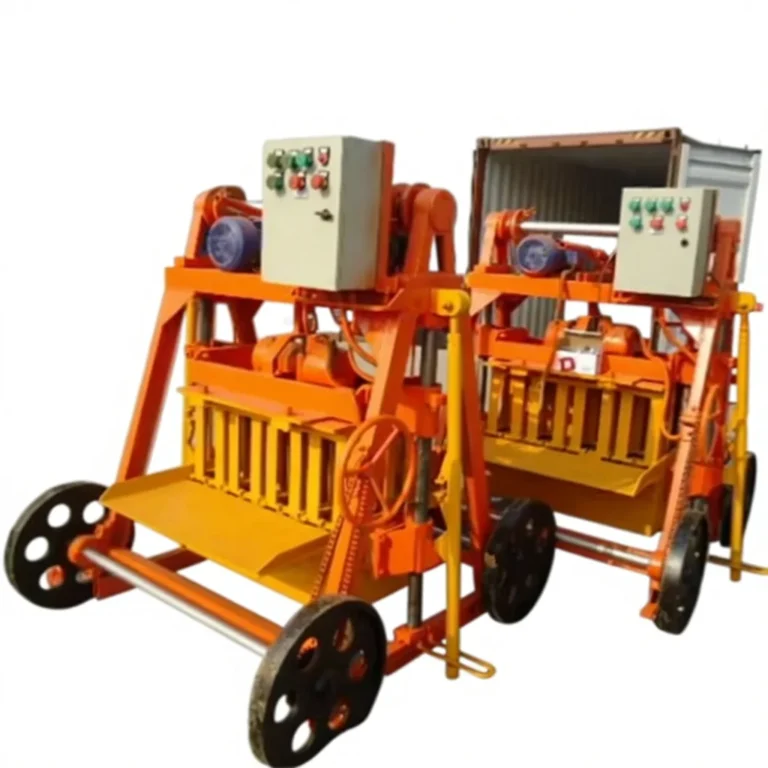 Mobile block machine