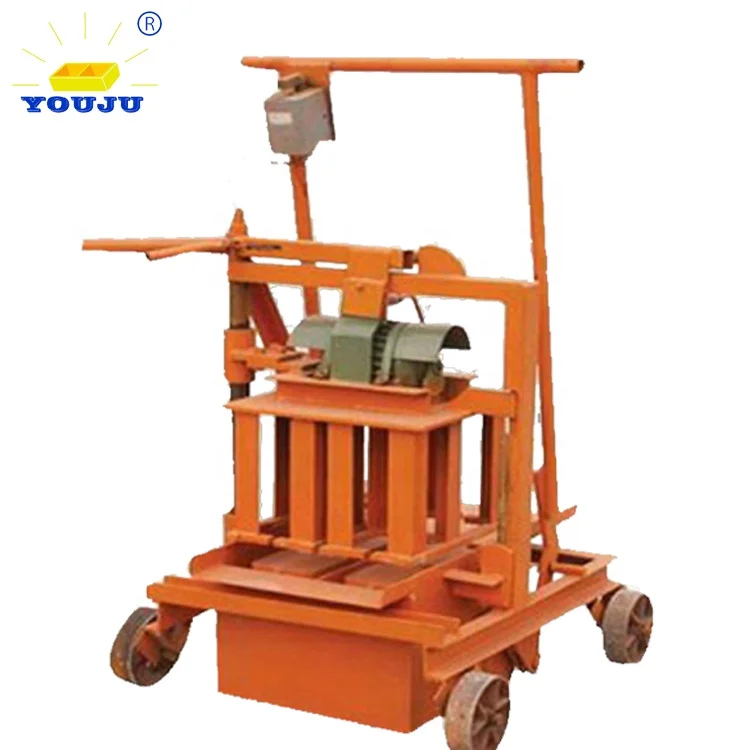
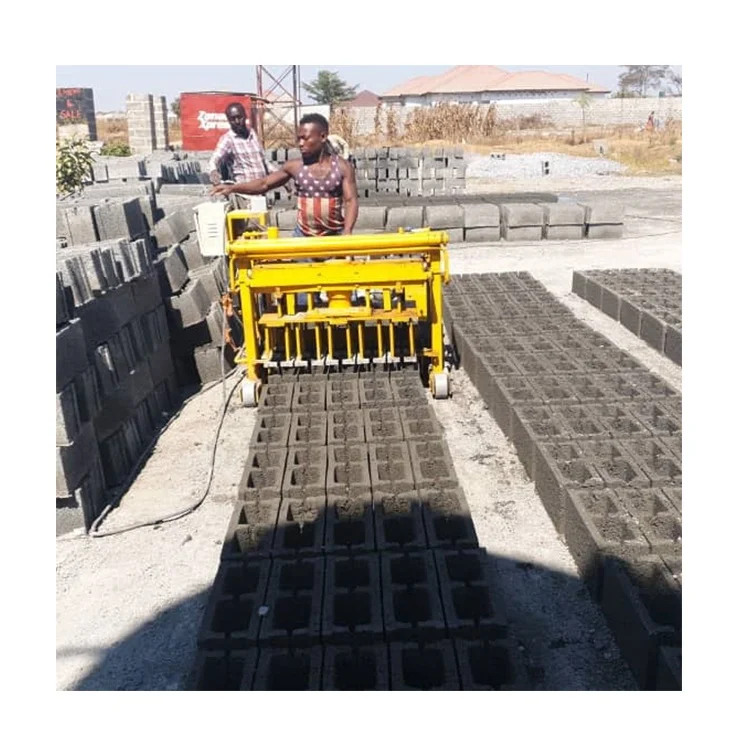
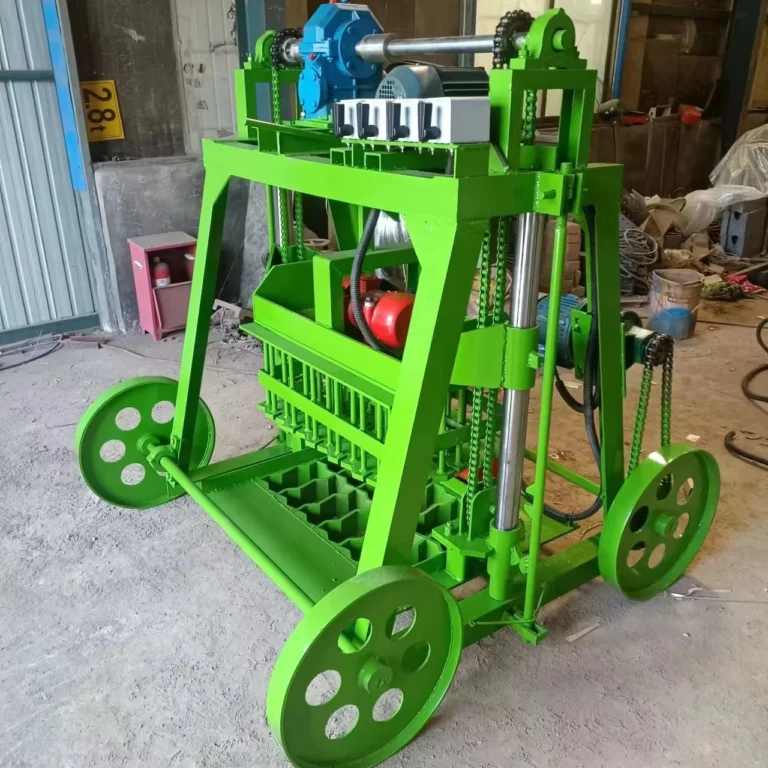
Pallet-Free Starting Point — the QMJ2-45 sits at the entry tier of the complete block machine range, eliminating pallet investment while leaving a clear path toward semi-automatic and automatic configurations.
Technical Specifications
| Parameter |
Value |
| Model |
QMJ2-45 |
| Product Type |
Mobile Egg-Laying Block Making Machine |
| Machine Format |
Mobile / egg-laying (pallet-free operation) |
| Automation Level |
Semi-automatic / manual operation |
| Power Source |
Electric (voltage and frequency to be confirmed before order) |
| Mould System |
Interchangeable moulds for multiple hollow brick formats |
| Labour Requirement |
1 to 3 workers |
| Footprint |
Small, free-moving on site without fixed foundations |
| Cycle Time |
25–30 s (basis not stated in source — confirm against block format and material) |
| Output — 400×200×200 mm |
160 pcs/h (2 pcs per mould) |
| Output — 400×150×200 mm |
240 pcs/h (3 pcs per mould) (source value — verify against actual cycle) |
| Output — 400×100×200 mm |
320 pcs/h (4 pcs per mould) |
| 8-Hour Output — 400×200×200 mm |
1,280 pcs |
| 8-Hour Output — 400×100×200 mm |
2,560 pcs |
| Pallet |
Not required |
| Hydraulic Pressure |
Not applicable (mechanical / egg-laying type) |
| Control System |
To be confirmed |
| Standards |
ISO 9001:2000, CE (claimed — verify certificate validity and scope) |
Application Suitability
| Application |
Material or Output |
| On-site hollow block production at building project locations |
Local crushed stone, river sand and cement mixes laid directly on prepared ground |
| Small-scale block plant with limited capital |
Hollow bricks in 400×200×200, 400×150×200 and 400×100×200 mm formats |
| Contractor self-supply for housing or wall projects |
Low-volume daily runs with 1 to 3 operators and no fixed curing rack system |
| First brick plant for entrepreneurs entering the market |
Entry-tier output on a compact footprint before scaling to stationary lines |
What "160 Pieces per Hour" Actually Means on Site
A capacity number without a block format attached is not a capacity number — it is a guess.
I have watched buyers compare two machines purely on a headline hourly figure, only to discover after commissioning that the number assumed the smallest block in the mould catalogue. The QMJ2-45 rates at 160 pcs/h specifically on 400×200×200 mm hollow bricks with a 2-cavity mould, and the cycle time of 25–30 s still needs confirming against your actual mix and wall thickness. When local aggregate has high clay content, vibration transfer drops and cycle times stretch; the output you planned around simply does not materialise over a full shift [NEED_CITE: effect of aggregate clay content on block machine cycle time]. This is why every figure in the table above is tied to a specific format and cavity count — so you can compare honestly before money changes hands.

Where the QMJ2-45 Sits on the Full Machine Range
The complete block machine lineup runs from this pallet-free mobile tier through semi-automatic stationary machines and up to high-capacity fully automatic lines with batching, stacking and cubing. Choosing the QMJ2-45 means you are starting at the lowest investment and smallest footprint position, accepting manual pallet-free operation in exchange for immediate on-site production capability. A mobile block making machine for sale at this tier suits project contractors who need blocks directly where the walls are going up, without building a fixed plant first.
The Upgrade Path Built Into the Range
Starting on the QMJ2-45 does not lock you into manual operation permanently. The same product family scales upward to semi-automatic stationary machines with pallet systems, then to fully automatic lines with PLC control and automatic stacking [NEED_CITE: block production line automation levels and labour requirements]. Buyers who begin with the mobile tier and later move to a stationary configuration already understand block format, mix design and local market demand — knowledge that makes the next investment far more targeted than buying a full automatic line on day one without production experience.
Reading the Specs That Matter for Mobile Operation
The egg-laying design means the machine moves forward after each cycle, depositing blocks directly on the ground — no pallets, no pallet-return conveyor, no curing-area pallet logistics. This keeps the capital outlay low and the site footprint compact, but it also means the ground surface must be level and firm enough to accept freshly formed hollow bricks without deformation. Labour sits at 1 to 3 workers: one feeding the hopper, one guiding the machine, and one managing the freshly laid blocks. The interchangeable mould system covers three standard hollow brick formats, though a mobile block making machine for sale in this class changes moulds manually, so the time and tools required should be confirmed before you commit to producing multiple formats in a single shift. Voltage and frequency are not stated in the draft specification and must be confirmed to match your site supply before the machine is built.
When the Wrong Configuration Costs You a Shift
A machine specified for a mix you cannot source locally forces a material change that was never in your budget. I once saw a contractor in the Pearl River Delta take delivery of a mobile egg-laying machine without declaring that the local river sand carried heavy clay content; on the first day of production, block edges collapsed the moment the mould lifted, and daily output dropped by roughly half. The vibration force and the material simply did not match [NEED_CITE: vibration force matching to aggregate type in block production]. The same problem applies to voltage: arrive on site with a motor wound for the wrong frequency and commissioning stops before it starts. These are not machine defects — they are specification gaps that surface only after the crate is open.
Why Source This Tier Here
Block machinery is the single focus here, which means the QMJ2-45 is specified alongside its moulds, power supply requirements and handling context as one matched package rather than assembled from separate catalogues. Configuration is set against your actual mix design, local aggregate and target block format instead of a default brochure setting. Mould design covers the formats your market actually sells, with custom drawings available when standard sizes do not match. The automation level is selectable across the range, so you can begin on this mobile tier and move upward without changing suppliers. Installation support, commissioning guidance and operator training are included so the first production run does not become a troubleshooting exercise.
Documentation & Verification
- Line layout stating the block format assumed for every output figure
- Machine specification sheet confirming voltage and frequency for your supply grid
- Mould drawing and format list showing all available hollow brick sizes with cavity counts
- CE declaration and ISO certificate with valid scope covering the supplied model
- Factory test record run on the agreed block format before dispatch
- Packing photographs and customs documentation support for container loading
Installation, Commissioning & Support
- Level, compacted ground surface required; no fixed foundations for the QMJ2-45 mobile chassis
- Voltage and frequency confirmed before build to avoid on-site rewiring delays
- Machine arrives assembled; mould installed and first test cycle run during commissioning
- Operator training covers hopper feeding rhythm, machine travel speed and mould change procedure
- Mould and mechanical wear parts list supplied for first replacement planning
- Daily greasing points identified on vibration box and guide rails during handover
What We Need to Configure the Right Machine for You
Share the hollow brick format you intend to sell, the daily volume you are targeting and the raw materials available locally — especially sand type and clay content. Let us know the site voltage and frequency, the language you need on any control interface and the ground conditions where the machine will operate. If you already have curing space or handling equipment, describe it so the line layout accounts for what is already there.
Frequently Asked Questions
Q: How is the output capacity calculated and which block format does it assume?
A: Each capacity figure is tied to a specific hollow brick size and mould cavity count — for example, 160 pcs/h assumes 400×200×200 mm blocks on a 2-cavity mould. A single unqualified hourly number is never used. Your actual output also depends on mix design, aggregate properties and operator rhythm, so the stated figure is a reference, not a guarantee.
Q: Where does the QMJ2-45 sit on the full range and what does upgrading add?
A: The QMJ2-45 is the entry mobile tier. Moving up introduces pallet-based stationary machines with higher output, then fully automatic lines with PLC control, automatic stacking and cubing. Each step reduces manual labour and increases daily volume while keeping block format and mould compatibility within the same product family.
Q: What voltage and frequency options are available for my market?
A: Voltage and frequency are not preset and must be confirmed before the machine is built. Provide your site supply specification — including whether you run 50 Hz or 60 Hz — so the motor and any control components are wound correctly and commissioning is not delayed on arrival.
Q: What site conditions does this mobile machine require compared with a stationary line?
A: The QMJ2-45 needs level, firm ground with no fixed foundations and no pallet system. A stationary line requires a prepared slab, pallet circulation space and curing racks. The mobile machine sacrifices some output consistency for a much smaller footprint and lower initial investment, suiting project sites and first plants.
Q: Which mould formats are available and how long does a change take?
A: Standard interchangeable moulds cover 400×200×200, 400×150×200 and 400×100×200 mm hollow bricks. Custom mould drawings are available on request. Mould changes are manual on this tier, so the time and tools required should be confirmed in advance if you plan to run multiple formats in one shift.

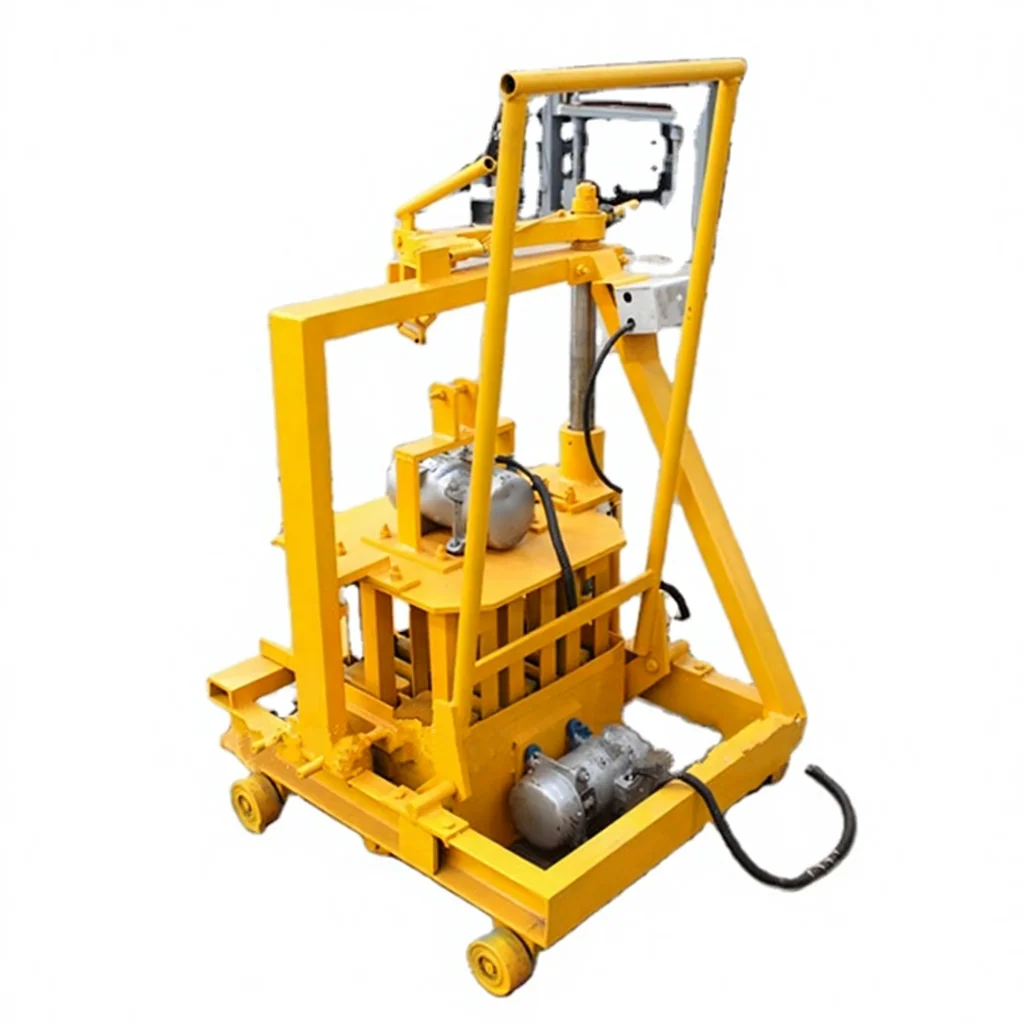
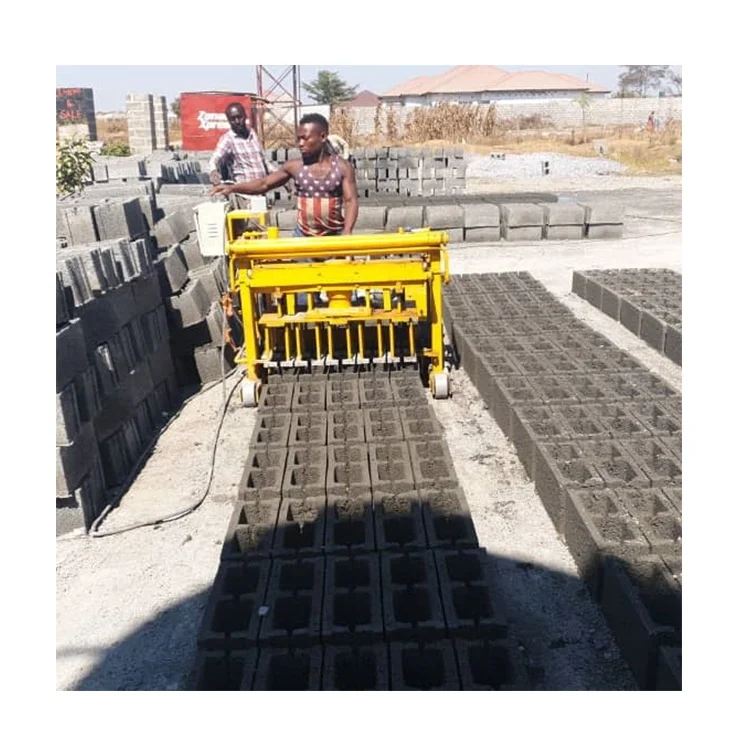 Mobile block machine