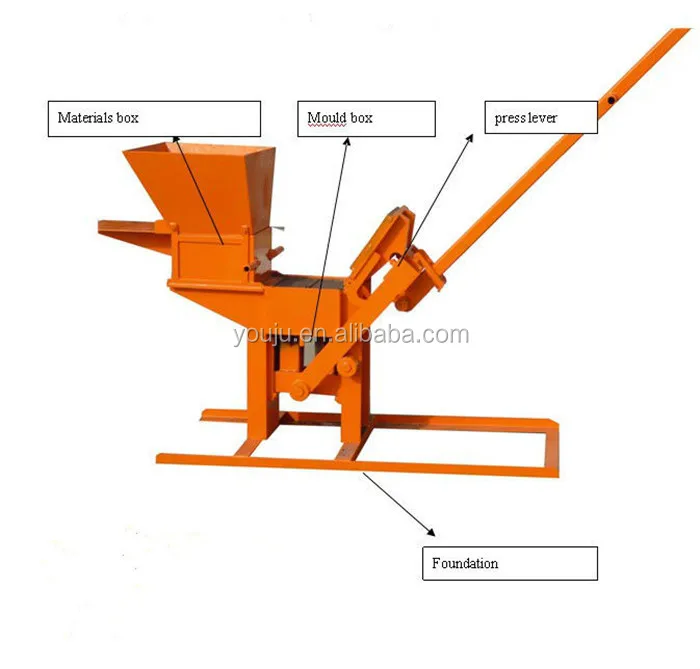
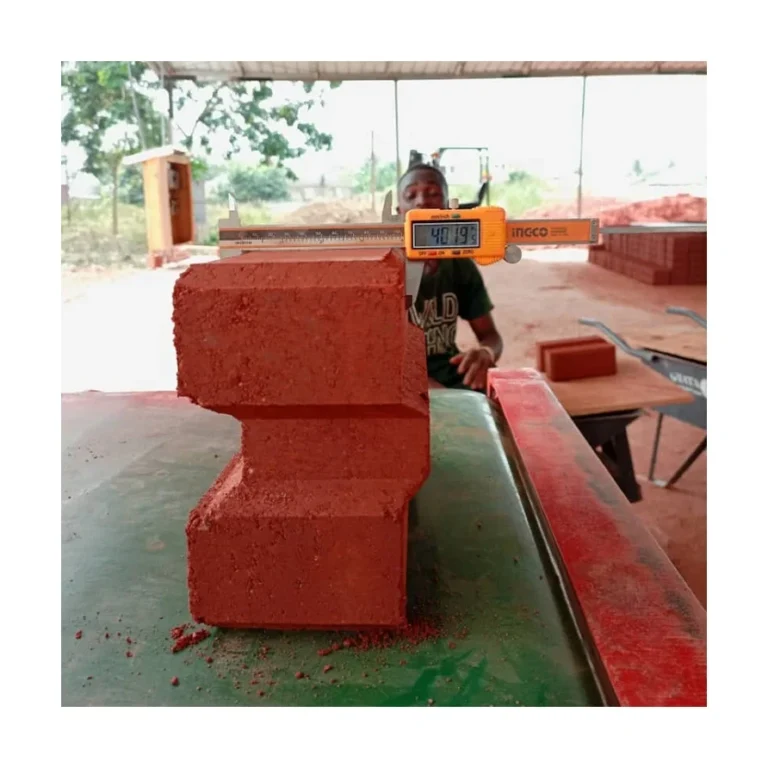
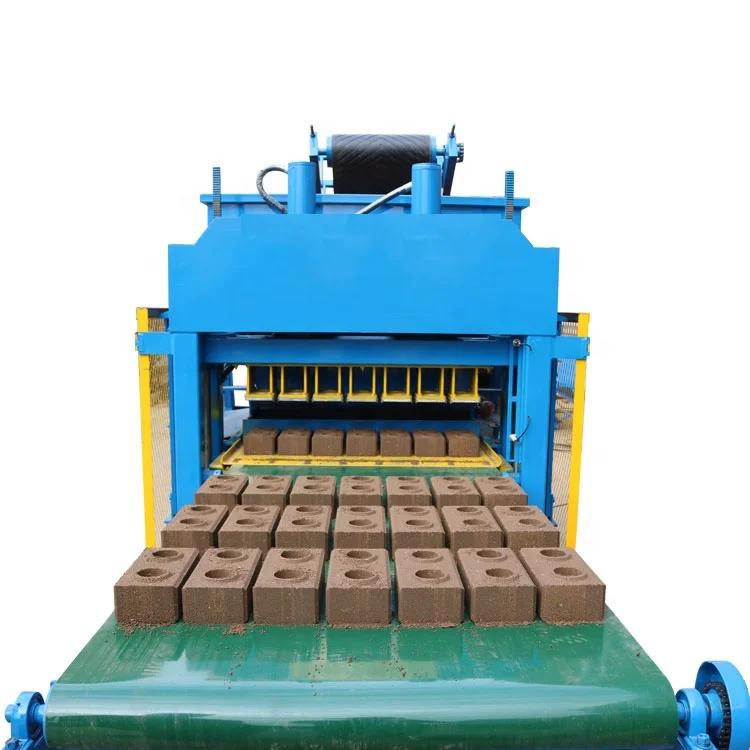
Zero-Grid Operation — the LY2-40 manual clay interlocking brick machine is built as the lowest-investment entry point, engineered to run entirely without electricity on remote or off-grid sites.
Technical Specifications
| Parameter |
Value |
| Model |
LY2-40 |
| Product Type |
Manual Clay Interlocking Brick Machine |
| Power Source |
No Power, Completely Manual |
| Lifting System |
Manual |
| Mobility |
Steel wheels for mobile operation |
| Mould Change |
Changeable for various block formats |
| Molding Cycle |
30-40s |
| Capacity |
400-1000 pcs/day (basis not stated in source — confirm block format / material / thickness) |
| Overall Dimensions (L×W×H) |
1600 × 700 × 1200 mm |
| Total Mass |
200-240 kg |
| Warranty |
1 Year |
| Recommended Basic Equipment |
JFA-1 Mixer or JQ350 Mixer |
Application Suitability
| Application |
Material or Output |
| Off-grid interlocking brick production |
Local clay and cement mixes without grid electricity |
| On-site housing project construction |
Clay interlocking bricks produced at the building location |
| Small-scale first brick plant for entrepreneurs |
Low-volume interlocking block formats for local markets |
| Building material distribution in remote regions |
Clay-cement interlocking bricks for resale where power is unreliable |
What "400-1000 Pieces per Day" Actually Means for the LY2-40
Daily output depends entirely on which interlocking brick format you press and how your local clay behaves under manual compaction.
When a manual clay interlocking brick machine manufacturer quotes a capacity range without stating the block format, buyers often find their real daily production falls far short of expectation. A thicker interlocking profile takes longer to fill, compress, and release than a slim paving format, and sticky high-clay soils slow the cycle compared to sandy blends. Before you commit, the capacity calculation must name the exact brick dimension and mix being assumed. [NEED_CITE: capacity calculation standards for manual block presses]

Where the LY2-40 Sits on the Block Machine Range
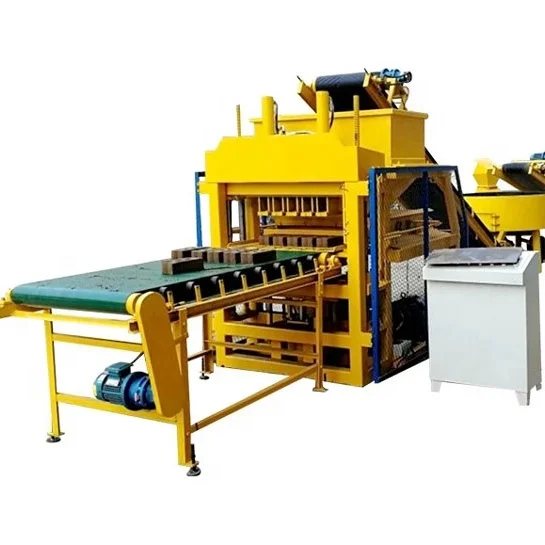
The LY2-40 occupies the entry tier of our block machine lineup — a fully manual, zero-power press designed for buyers who need interlocking brick production without any electrical infrastructure. For a first-time entrepreneur or a contractor producing on a remote housing site, this model removes the power dependency that disqualifies hydraulic or vibratory machines from consideration.
Mobility Without a Fixed Plant Foundation
Steel wheels allow the LY2-40 to move across a construction site as the building progresses, eliminating the need for a fixed production yard and the material transport costs that come with it. Contractors producing clay interlocking bricks directly at the pour location cut handling labor and reduce breakage from moving cured blocks over rough ground. [NEED_CITE: on-site block production logistics for rural housing projects]
Reading the Specs That Actually Matter
The 30-40s molding cycle sets the pace for everything downstream: how fast your team can feed the mixer, move raw bricks to the curing area, and keep the press supplied with prepared clay. At the slower end of that cycle, sticky or high-moisture clay demands longer pressing and careful release, which directly reduces daily output. The 1600 × 700 × 1200 mm footprint means the machine occupies minimal ground, but you still need curing rack space proportional to your daily volume — a factor buyers frequently overlook when sizing their first manual plant.
The Cost of Skipping a Mix Trial Before Ordering
I once watched a client run standard red clay through a manual interlocking press and get consistent, strong bricks all day. When the same machine arrived at his actual site with high-sand soil, the bricks crumbled at the edges and half the first batch was unsellable. The press was fine; the local aggregate was not matched to the mould geometry or the manual compaction force available. Running a sample of your actual site soil through a trial before finalizing the mould profile prevents that kind of costly mismatch. [NEED_CITE: local aggregate variation and block strength consistency]
Why Buyers Choose This Entry Tier
Block machinery is our single focus, so the LY2-40 is specified as a matched system — press, mould, mixer recommendation, and pallet handling — rather than assembled from unrelated suppliers. Configuration is set against your actual clay type and target interlocking format, not pulled from a catalogue default. Mould design covers the interlocking profiles your local market actually sells, with custom drawings available when standard profiles do not fit. Automation level is selectable across our range, so you can start with the LY2-40 and step up to semi-automatic when volume justifies it. Installation support and operator training come with the machine, and wear parts availability is confirmed before the first replacement is due.
Documentation & Verification
- Line layout and capacity calculation stating the interlocking brick format assumed for daily output
- Mould drawing and format list confirming which interlocking profiles ship with the press
- Factory test record demonstrating cycle time and brick density on your chosen clay mix
- Operation and maintenance manual with wear parts list for the LY2-40 manual mechanism
Installation, Commissioning & Support
- Level compacted ground required; no concrete foundation needed for the 200-240 kg LY2-40 frame
- No electrical connection required; manual operation eliminates power specification and wiring delays
- Machine ships assembled on steel wheels; unfold and position on-site within hours of arrival
- First-run calibration of mould release timing against your specific clay moisture content
- Operator training on cycle rhythm, feed volume, and manual lifting technique for consistent density
- Wear parts list covering press contact surfaces and mould liner replacement intervals
What to Include With Your Inquiry
Tell us which interlocking brick profile your market sells, the daily volume you need to sustain, and what clay or soil is available at your site. If your project runs on a construction deadline, state the arrival date you are working toward so we can confirm dispatch timing.
Frequently Asked Questions
Q: How is daily output calculated and what block format does the capacity figure assume?
A: The 400-1000 pcs/day range depends on the interlocking brick format pressed, the molding cycle achieved with your specific clay, and shift length. We state the capacity calculation against a named block dimension and mix so you can verify daily output before ordering, rather than discovering the gap after the machine arrives on site.
Q: What interlocking brick profiles can the LY2-40 produce and are custom moulds available?
A: The press accepts changeable moulds for multiple interlocking formats. We supply mould drawings and a format list with the quotation so you see exactly which profiles are included. Custom mould design to your drawings is available when standard profiles do not match the profile your local construction market demands.
Q: What is the investment difference between this manual tier and a semi-automatic block machine?
A: The LY2-40 removes electricity and hydraulic system costs entirely, placing it at the lowest entry point in our range. Semi-automatic models add powered mixing, vibration, and pallet feeding for higher volume. Buyers typically upgrade when daily output requirements exceed what a manual cycle rhythm can sustain with available labor.
Q: What raw material mix and local soil conditions are needed for consistent interlocking brick strength?
A: Manual compaction depends heavily on clay moisture content and sand-to-clay ratio. High-sand soils may not bind well under hand pressure, while overly wet clay slows the cycle and weakens edges. We recommend a mix trial using your actual site soil before the mould profile is finalized to avoid costly rework after delivery.

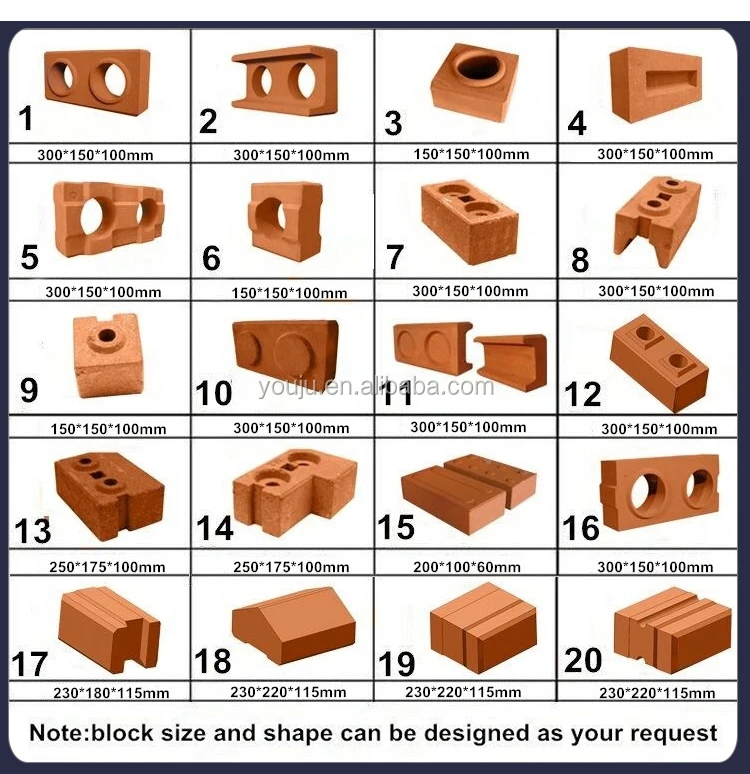
 Clay interlocking brick