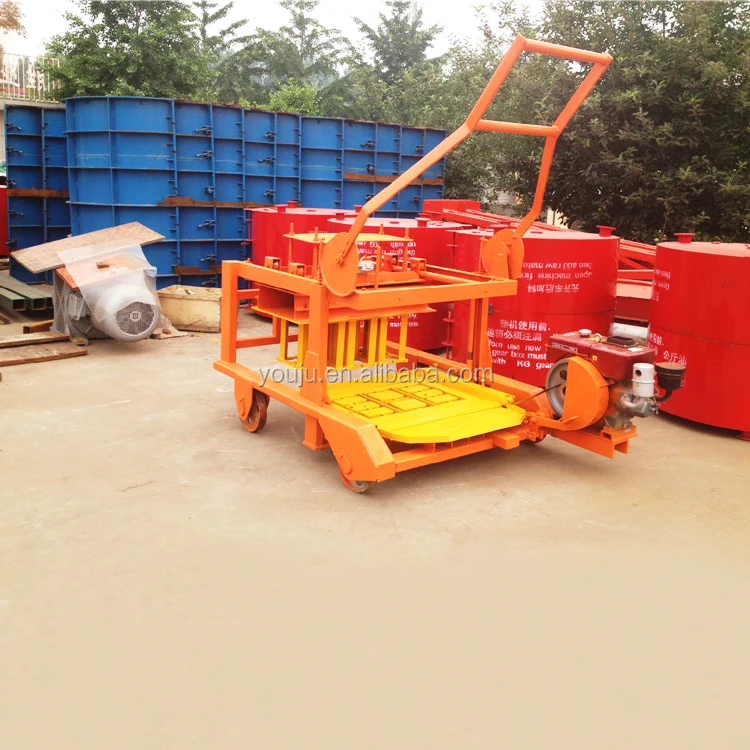
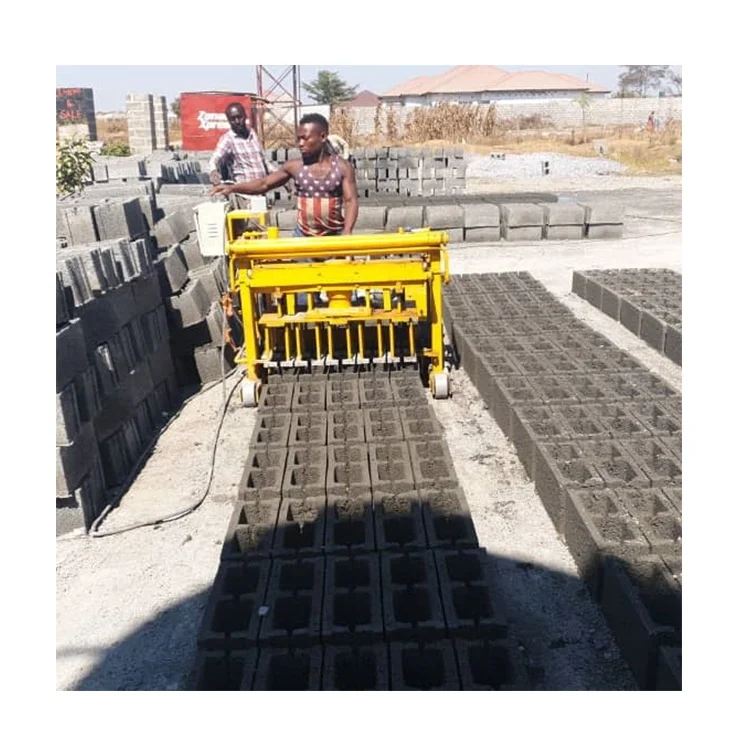
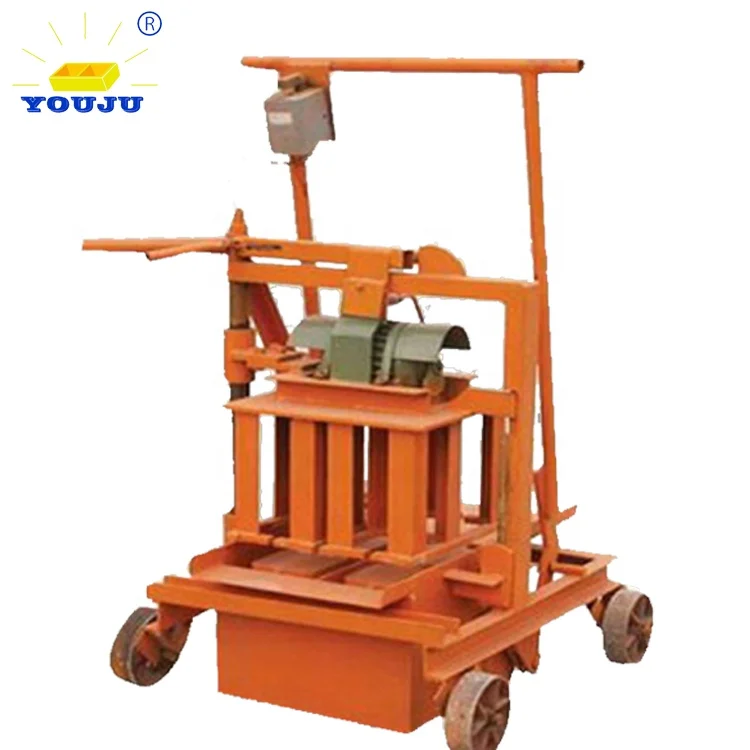
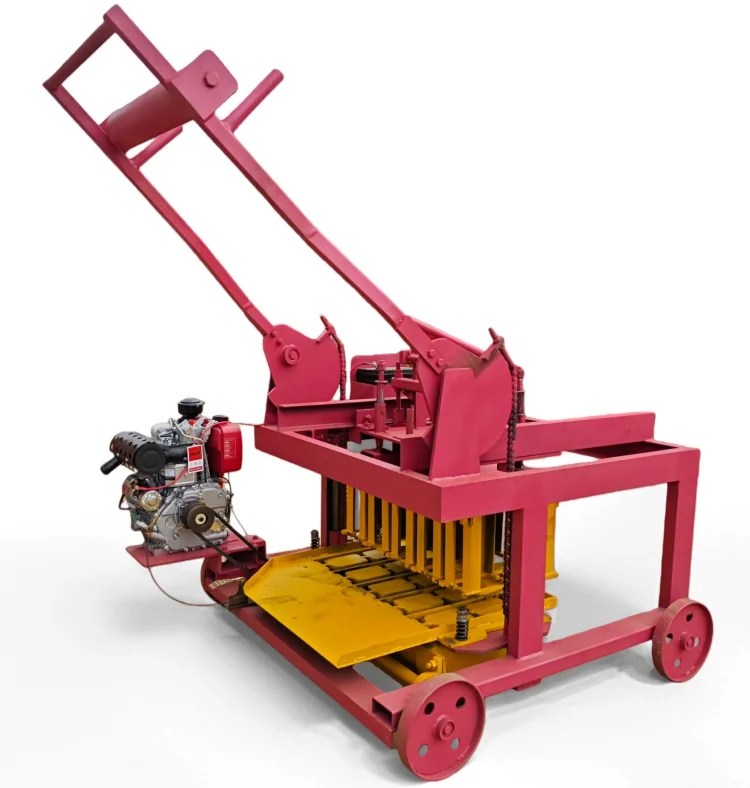
Engine-driven mobility — the QMJ4-45 egg-laying block machine bypasses site electrical dependencies entirely by running on a standard diesel or petrol engine, letting contractors produce hollow blocks directly on uneven ground without pallets or a fixed plant.
Technical Specifications
| Parameter |
Value |
| Model |
QMJ4-45 |
| Product Type |
Egg Laying Block Making Machine |
| Molding Capacity |
4 pcs/mold (basis: 400×200×200mm hollow block) |
| Molding Cycle |
40–45 seconds |
| Vibration Frequency |
2400 r/m |
| Productivity (400×200×200mm) |
3000 pcs/day based on an 8-hour shift |
| Productivity (400×150×200mm) |
3500 pcs/day based on an 8-hour shift |
| Productivity (400×120×200mm) |
4500 pcs/day based on an 8-hour shift |
| Forming Method |
Twice-vibration mold molding |
| Demold & Turning Method |
Manual |
| Power Source |
Diesel or petrol engine |
| Total Power |
6 kW |
| Pallet Requirement |
None (egg-laying, produces directly on ground) |
| Automation Level |
Manual mobile |
| Voltage & Frequency |
Not applicable (engine driven) |
| Warranty |
One year for the whole machine |
Application Suitability
| Application |
Material or Output |
| On-site hollow block production for building contractors |
Crushed stone, river sand, and cement mixes laid directly on compacted soil |
| First block plant setup for entrepreneurs |
Standard concrete hollow blocks in 400×200×200mm, 400×150×200mm, and 400×120×200mm formats |
| Remote housing projects without grid electricity |
Engine-powered block making in areas where three-phase power is unavailable |
| Small-scale concrete product workshops |
Low-volume solid and hollow blocks where pallet infrastructure does not exist |
What "3000 Blocks per Day" Actually Means on Site
Every output figure on this page is tied to a specific hollow block dimension and a full eight-hour shift — no generic cycles-per-hour claims.
Buyers often receive quotations that quote a single daily number without revealing which block format it assumes. A machine that produces 3000 pieces of 400×200×200mm hollow blocks in eight hours will yield a different count when the mould is swapped to a smaller 400×120×200mm format. Without that clarity, a contractor planning a housing project can end up short on the first delivery day. When we configure a QMJ4-45 egg laying block machine manufacturer order, we state the capacity per format so the buyer knows exactly what to expect before the machine ships. [NEED_CITE: block format and cycle time relationship in mobile block production]

Where the QMJ4-45 Sits in the Full Block Machine Range
The QMJ4-45 occupies the entry point of the block machine range. It is a mobile egg-laying press designed for buyers who need on-site production without investing in a fixed plant, conveyor systems, or pallet circulation infrastructure. For a first-time buyer surveying options, this model defines the floor: manual operation, engine power, and ground-level block laying. Understanding this tier helps a buyer decide whether a mobile unit meets their volume or whether they should move up to a semi-automatic stationary line. The QMJ4-45 egg laying block machine manufacturer range starts here and scales upward through semi-automatic and fully automatic configurations.
Choosing Between Mobile, Semi-Automatic, and Automatic Tiers
A mobile egg-laying machine like the QMJ4-45 removes the need for pallets, curing racks, and a prepared factory floor. The trade-off is that every step — feeding the mould, moving the machine forward, and demolding — relies on manual effort. Semi-automatic stationary lines introduce pallet feeding and mechanical vibration but still require operators to handle stacking. Fully automatic lines add PLC-controlled batching, automatic stacking, and cubing. The investment and plant footprint grow with each step, so a buyer must weigh current daily volume against available capital and site space before selecting a tier. [NEED_CITE: comparison of investment levels across block machine automation tiers]
Reading the Vibration and Cycle Specs
The 2400 r/m vibration frequency and the twice-vibration molding core work together to compact the concrete mix inside the mould cavity. Single-vibration designs send force in one direction, which can leave density variation across taller block walls. The twice-vibration approach applies compaction from two points, producing more consistent density throughout the 400×200×200mm hollow block. The 40–45 second molding cycle is the time from mould fill to demold for the standard hollow block format. Shorter cycles are possible with thinner blocks, while denser mixes may require the full 45 seconds. The 6 kW total power rating reflects the energy needed to drive both the vibration motor and the mould-lifting mechanism through the diesel or petrol engine.
The Hidden Cost of Skipping the Raw Material Test
A machine set up for river sand will behave differently when fed a coarse volcanic ash or crushed granite aggregate. The vibration force and moisture content that produce clean hollow blocks with one mix may cause cracking or crumbling with another. We have seen contractors lose an entire shift of output before identifying that their local aggregate absorbs water at a different rate than the test mix used at the factory. Sending a raw material sample before the machine is configured lets us adjust the vibration setting and recommend a moisture range that matches what the buyer will actually pour on site. [NEED_CITE: effect of local aggregate characteristics on block density and surface quality]
Why Source This QMJ4-45 Egg Laying Block Machine Manufacturer Configuration Here
Block machinery is our single focus, which means the QMJ4-45 machine, its moulds, and the engine package are specified as one matched unit rather than assembled from unrelated suppliers. Configuration is set against the buyer’s actual mix design and target block format, not pulled from a catalogue default. Mould design covers the hollow block sizes the buyer’s market demands, including custom drawings when a non-standard format is needed. The automation level is selectable across the broader range, so a buyer starting with the QMJ4-45 can move to a semi-automatic line later without changing suppliers. Installation support includes on-site commissioning and operator training so the first production run happens with supervision, not guesswork.
Documentation & Verification
- Line layout and capacity calculation stating the hollow block format assumed for each output figure
- Machine specification sheet confirming engine type, vibration frequency, and 40–45 s molding cycle
- Mould drawing and format list covering all available hollow block dimensions
- Operation and maintenance manual including engine servicing intervals and mould care instructions
- Factory test record run on the buyer’s specified block format before dispatch
- Packing photographs and customs documentation support for international shipment
Installation, Commissioning & Support
- Ground preparation guidance: the QMJ4-45 requires a level, compacted surface — no concrete foundation or pallet system needed
- Engine start-up and vibration tuning performed on site with the buyer’s own raw material mix
- Manual demold technique and mould-change procedure demonstrated during operator training session
- Mould and vibration motor wear parts list provided with recommended replacement intervals
- One-year warranty covering the complete QMJ4-45 machine with remote video troubleshooting support available
What to Share Before Requesting a Quotation
To match the right configuration, provide your target hollow block dimensions, the daily output you need on an eight-hour shift, and the type of aggregate available at your project site. Confirm whether grid electricity exists or if an engine-driven unit is necessary. If you already run a concrete mixer or have a specific curing area layout, mention those so the supporting equipment can be aligned before the quotation is prepared.
Frequently Asked Questions
Q: How is daily output calculated and which block format is assumed for each figure?
A: Each output number on this page is based on a specific hollow block size and an eight-hour shift. For example, 3000 pieces per day applies to 400×200×200mm hollow blocks at a 40–45 second cycle. When the mould is changed to 400×120×200mm, the count rises to 4500 pieces per day because more units fit in each mould cycle. We state the format alongside every figure so there is no ambiguity.
Q: Where does the QMJ4-45 sit compared to semi-automatic and automatic block machines?
A: The QMJ4-45 is the entry tier — a manual mobile egg-laying machine with no pallets, no fixed plant, and engine power. Semi-automatic lines add stationary presses with pallet feeding and mechanical systems. Automatic lines include PLC control, batching, stacking, and cubing. Investment and site footprint increase at each step, so buyers should match their current volume and capital to the right tier.
Q: What site conditions does an egg-laying machine require?
A: The QMJ4-45 produces blocks directly on the ground, so no pallets or curing racks are needed. The surface must be level and compacted enough to support freshly molded blocks without settling. Adequate space for the machine to travel forward after each cycle and a nearby area for mixing and feeding raw materials are the main site requirements.
Q: Can the QMJ4-45 be upgraded to a stationary semi-automatic line later?
A: Yes. The QMJ4-45 egg laying block machine manufacturer range is part of a broader product line that scales from mobile manual units through semi-automatic and fully automatic stationary lines. Buyers who start with the QMJ4-45 can transition to a higher tier as their production volume and capital grow, and mould formats can carry over where pallet sizes align.
Q: What engine options are available and how do they affect operation?
A: The QMJ4-45 can be fitted with a diesel or petrol engine, eliminating the need for grid electricity on remote sites. Engine choice depends on local fuel availability and cost. Both options deliver the 6 kW total power required to run the vibration motor and mould mechanism through a full eight-hour shift.

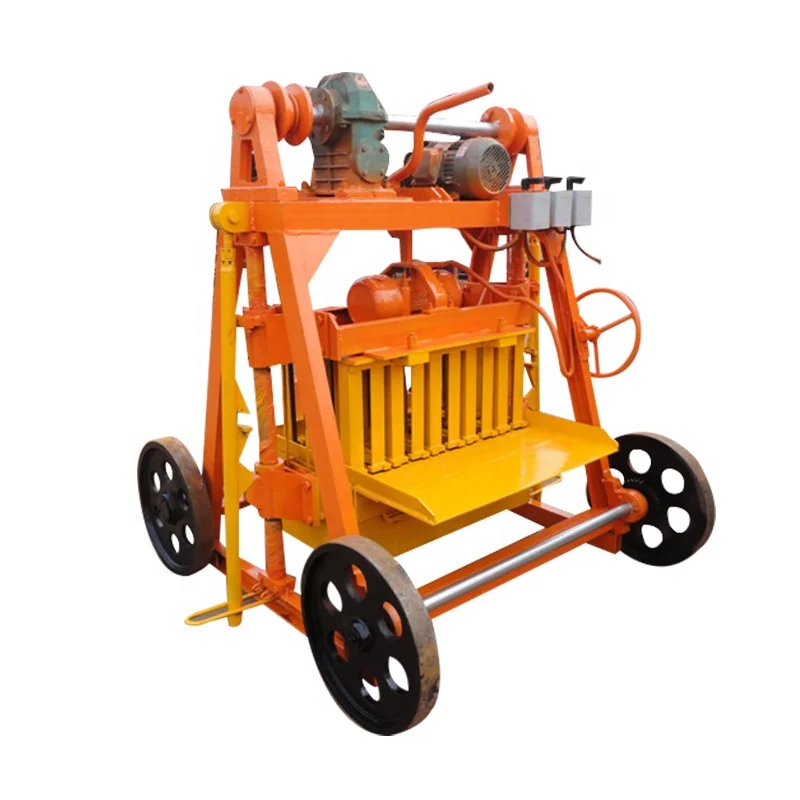
 Mobile block machine