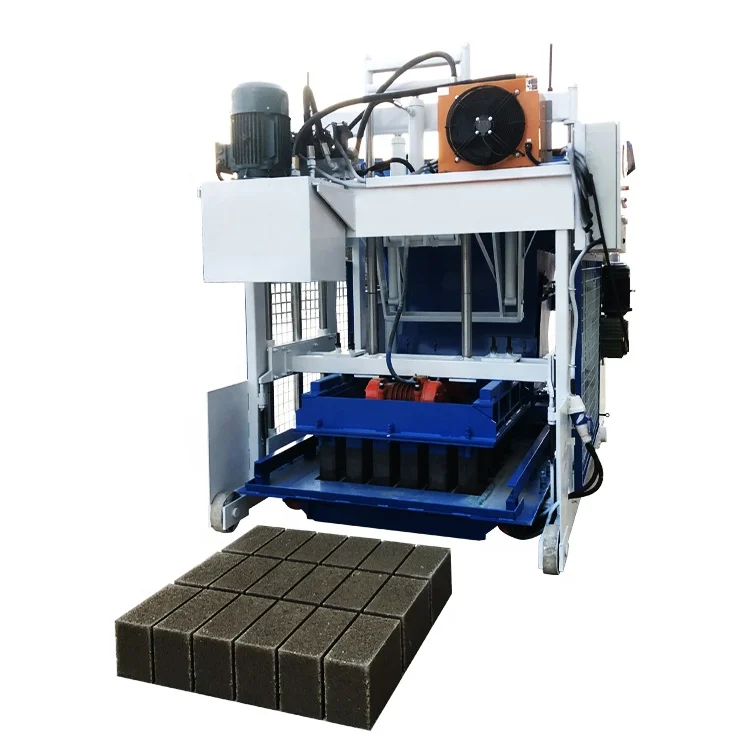
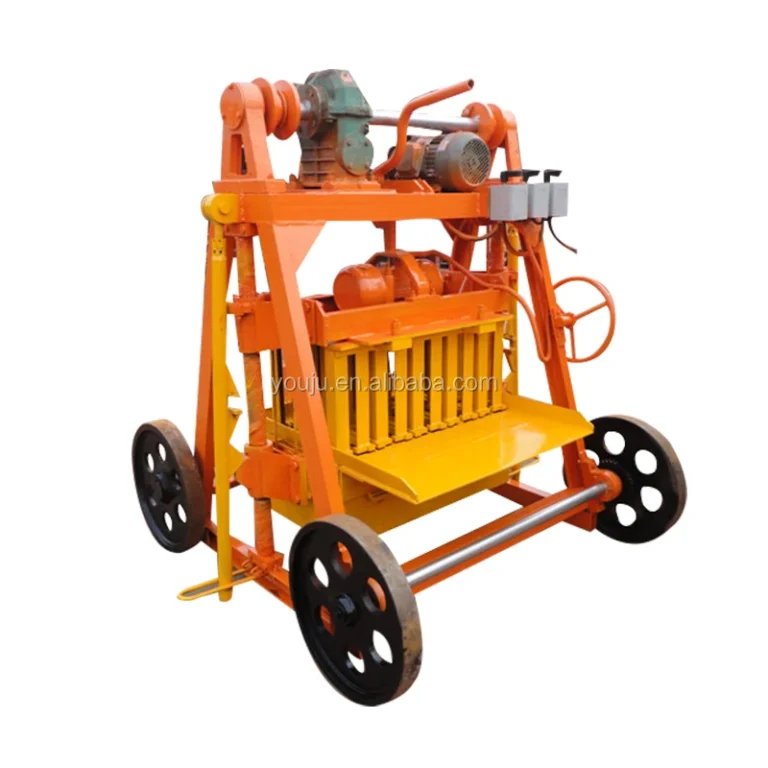
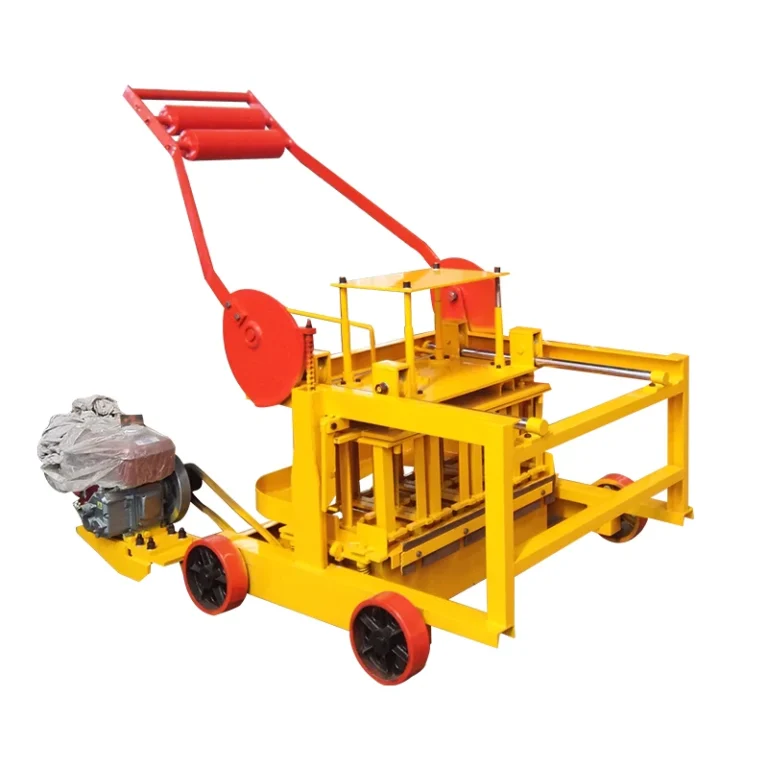
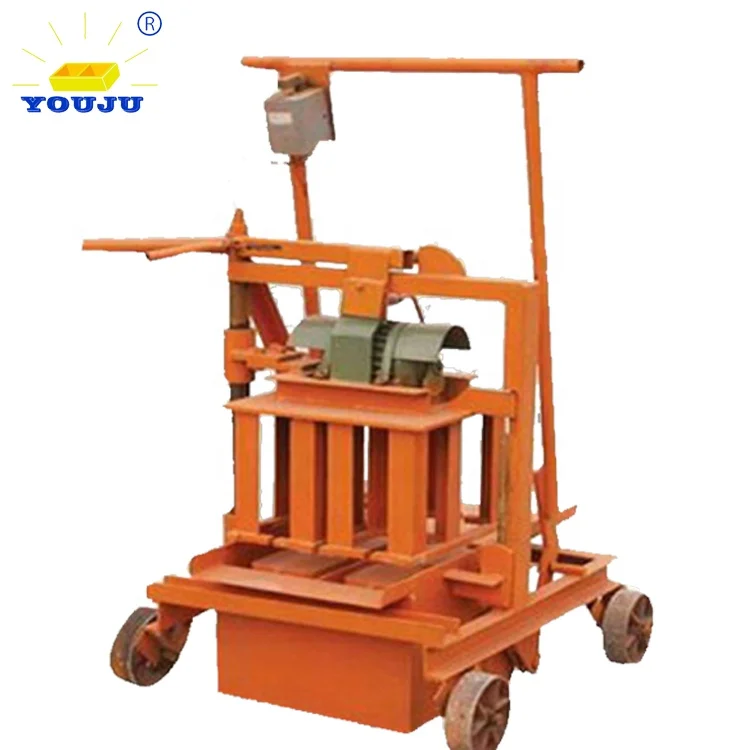
Matched System Focus — The QMR4-45 is specified as a complete mobile block making unit with its mould, power source, and optional mixer rather than a standalone press, removing the guesswork for buyers sourcing their first on-site production line.
Technical Specifications
| Parameter |
Value |
| Model |
QMR4-45 |
| Product Type |
Mobile Concrete Block Making Machine |
| Overall Dimensions (L×W×H) |
1100 x 950 x 2100 mm |
| Net Weight |
810 kgs |
| Molding Cycle |
30-45 s |
| Power Source Options |
Diesel Engine / Petrol Engine / Electric Motor |
| Output Capacity |
2560 pcs/day (basis not stated in source — confirm block format / material / thickness) |
| Pallet Requirement |
None (egg-laying / ground-cured) |
| Mobility |
Mobile / Movable on-site |
| Supported Block Formats |
Paver brick, hollow block, concrete block, solid brick, fly ash brick |
| Supporting Equipment (Optional) |
JZC350 Diesel Concrete Mixer, JQ350 Diesel Concrete Mixer, Trolley |
| Control System |
Manual operation with simple linear structure |
| Warranty |
1 Year |
Application Suitability
| Application |
Material or Output |
| On-site housing project production |
Hollow blocks and solid bricks directly on the building site |
| Remote infrastructure development |
Paver bricks and kerbstones using diesel power where grid is unavailable |
| Small-scale block manufacturing |
Concrete blocks from local crushed stone, sand, and cement |
| Entrepreneur start-up plants |
Fly ash bricks and solid blocks with low initial capital outlay |
What "2560 Pieces per Day" Leaves Out About Mobile Block Machine Output
Capacity figures mean nothing without the block format they assume.
When I was setting up a diesel-driven mobile block machine for an African contractor years back, the quoted output looked solid on paper. We arrived on site and found the local red soil mixed with coarse gravel behaved nothing like the river sand used in the factory test. The vibration frequency had to be completely re-tuned, and the effective daily output shifted accordingly. Any mobile block machine for sale listing a single daily number without naming the block size, mix design, and curing conditions is giving you half the story [NEED_CITE: block output calculation standards by format and mix].

Pallet-Free Production Eliminates the Hidden Cost Layer
The QMR4-45 mobile block machine for sale operates on an egg-laying principle, forming blocks directly onto a prepared ground surface and then moving forward for the next cycle. This removes the entire pallet investment — the purchase cost, the handling labour, the storage space, and the forklift traffic that a fixed-plant system demands. For a contractor producing blocks at a remote project site, this simplification is often the deciding factor.
Triple Power Source Flexibility for Off-Grid Sites
Construction sites in developing regions rarely offer reliable three-phase power. This mobile block machine for sale is available configured with a diesel engine, a petrol engine, or an electric motor, allowing the buyer to match the drive to whatever energy source the site actually has. A remote road-building crew running a diesel generator can keep production going without waiting for grid extension, while a peri-urban yard with stable electricity can cut fuel costs with the electric option.
Decoding the Core Specs That Drive Block Quality
The 30-45 second molding cycle reflects the manual operation sequence: the operator positions the machine, feeds the mix, triggers compaction, waits for the vibration cycle, then lifts and moves forward. On a hollow block, the longer end of that range allows the vibration to fully consolidate the thinner web sections. The 810 kg net weight provides the downward mass needed for compaction without a hydraulic press system — lighter machines of this type tend to produce blocks with lower compressive strength because the machine itself lifts off the ground during vibration [NEED_CITE: relationship between machine mass and block density in egg-laying machines]. The optional JZC350 or JQ350 mixer ensures the concrete reaches the hopper at a consistent workability, which directly affects how well the mix flows into the mould cavity during each cycle.
The Real Cost of Skipping Ground Preparation
An egg-laying mobile block machine for sale depends entirely on the ground surface acting as the curing bed. A buyer who levels only a rough area and starts production will find blocks cracking at the base, uneven dimensions across the batch, and the machine itself tilting during the vibration cycle. I have walked onto sites where the contractor assumed a compacted dirt floor was sufficient — it was not. The ground needs a concrete apron or at minimum a well-compacted gravel base with a smooth cement screed [NEED_CITE: ground preparation requirements for egg-laying block production]. Skipping this step turns a low-investment machine into a source of consistent waste.
Why Source This Machine Through a Matched-System Supplier
Block machinery as a single focus means the QMR4-45 arrives with a mould that matches your target block format, not a generic cavity that produces a block your local market will not buy. Configuration is set against your actual mix design and local aggregate — I insist on material samples before confirming the vibration frequency because a mismatch here causes cracking at demoulding. Mould design covers the formats your market sells, including custom drawings when a standard option does not fit. The automation level is selectable: you start manual and add a mixer and trolley as production scales. Installation support includes operator training on-site, not just a manual in a crate.
Documentation & Verification
- Line layout and capacity calculation stating the exact block format and mix assumed for your project
- Mould drawing and format list showing cavity dimensions for each block type ordered
- Voltage and control language confirmation sheet for electric-drive configurations before shipment
- Factory test record on your specified aggregate and block format before dispatch
- Operation and maintenance manual with wear parts and mould replacement schedule
Installation, Commissioning & Support
- Ground surface must be level concrete or compacted screed across the full production area to support 810 kg machine weight during vibration
- Electric motor configurations require confirmed voltage and frequency matching the site supply before the unit leaves the factory
- Diesel engine models ship with fuel line priming instructions and cold-start procedures for the local climate zone
- First production run supervised on-site with mix ratio and vibration duration adjusted to your specific aggregate
- Mould change process demonstrated with your operator using the included tools and format-specific moulds
- Wear parts list with reorder lead times provided so the first replacement does not halt production
Before You Request a Quote
Tell us the block format you sell most — hollow, solid, paver, or a specific dimension — so the capacity calculation reflects reality rather than a catalogue default. Share your local aggregate type and whether you have access to grid power, diesel, or only petrol on site. If you already have a mixer or trolley in your yard, let us know so the quotation covers only what you actually need.
Frequently Asked Questions
Q: How is the 2560 pcs/day capacity calculated and which block format does it assume?
A: That figure is a reference output and must be confirmed against your specific block format, wall thickness, and mix design. A standard hollow block will yield a different daily count than a thinner paver brick because the molding cycle and mould cavity volume change. We provide a format-specific capacity sheet with every proposal so you know exactly what to expect.
Q: Diesel, petrol or electric — how do I choose the right power source for my site?
A: The choice depends entirely on your site infrastructure. If you have stable three-phase grid power, the electric motor cuts running costs. Remote project sites without grid access need the diesel option, which pairs with a JZC350 diesel mixer for a fully off-grid line. Petrol suits smaller intermittent operations where fuel availability is limited.
Q: What block formats and mould options are available for the QMR4-45?
A: Standard moulds cover hollow blocks, solid bricks, paver bricks, and fly ash bricks. Custom moulds can be manufactured to your drawings for formats your local market demands. Mould change on the QMR4-45 is a manual process using basic tools, and we include the procedure during on-site operator training.
Q: What ground preparation is needed for pallet-free egg-laying production?
A: The production area requires a smooth, level concrete apron or well-compacted gravel base with a cement screed. The ground must be flat enough to prevent the machine from tilting during vibration and strong enough to support repeated block curing without surface degradation. We specify the preparation standard during the line layout phase.
Q: What is the mould change process and how long does a format switch take on site?
A: The mould is bolted to the machine frame and swapped using standard hand tools. The process involves unbolting the current mould, lifting it clear, positioning the new mould, and securing it. Your operators are trained on this during commissioning so the format switch does not consume an entire shift.

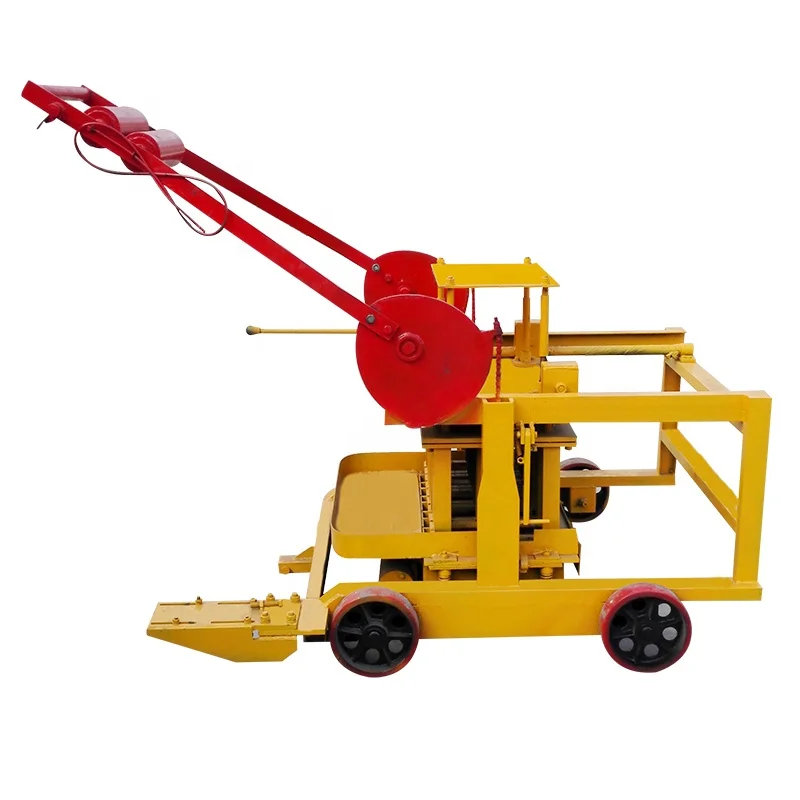
 Mobile block machine